Repository 241: Cognitive Impacts of Scent’s Languagelessness: A Persuasive Palette to Infuse Imagination & Healing
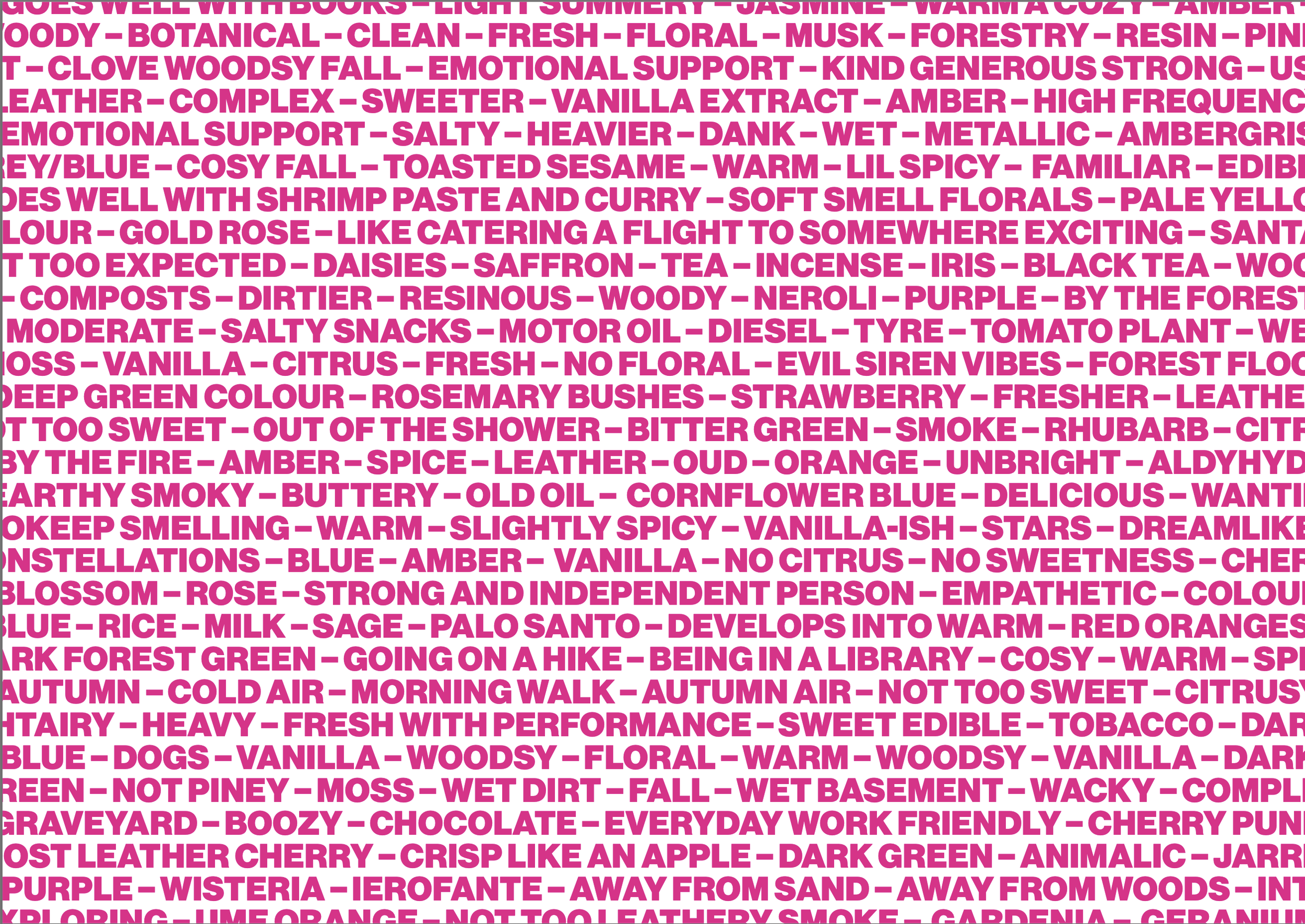
The following essay was published in the second annual “Nose Magazine” issue from Australia, published in March 2026. The illustration is from an ongoing Word Portrait project I am doing, the words were collected by Fumerie customers from their prompt to share words related to a smell they were looking for:
One way or another we share a commitment to the power of language and
its ability to transform our imagination and culture. Yet at no other moment
in time has our imagination been under such threat. The ability to control and
creatively perceive ourselves is left to invisible empires vying for our visual and
auditory attention. These empires, however, have no power over the language
of scent. Scent in situ resides outside of oppressive systems. Despite a massive
market valuation for scented products, the language of scent itself cannot be
commodified, owned or managed.
The language of scent is deliberately obtuse, capable of connecting and
embracing cross-cultural metaphors. It carries us back to our breathing selves,
into a full-bodied space of attraction and inclusion – or repulsion and exclusion.
Its mechanisms have no syntax, yet they are as powerful as the invisible
empires that govern our eyeballs. In this brief essay, I propose that scent is a
critical tool for strengthening parts of our brains that have lain dormant since
the rise of computer-based working and thinking over the past 40 years and
more drastically since 2004 with the advent of information catchers and
experience blockers. I believe that these crucial parts of the brain responsible
for sensing, feeling, and cognitive integration are atrophying in unprecedented
ways. Scent’s persuasive languagelessness is one of the keys to restoring full-
bodied healing, strength and an improved sense of self and connectedness.
The brain is a predictive machine. That means it is a guessing machine, never
with a single answer, only best guesses. What would it look like to prime this
predictive machine with more grey matter? Grey matter is all things full of doubt,
with soft edges, mysterious, usually invisible and unknown. Scent is a prime
example of persuasive grey matter that has deep, positive effects on the brain.
The only true assertion the mind can make is “I don’t know.” This is why what is
most persuasive is felt rather than known or measured. An invisible guide such
as scent, without structure or syntax, is therefore a key ingredient in discovering
new cognitive maps and meaning. The well-trodden paths of the brain thrive
on novelty and messiness, and scent is a most valuable player in this game
of chaos and wonder. The certainty of internet use is a fallacy, and in fact short-
circuits the critical grey space of uncertainty humans must inhabit to thrive.
The lack of scent language is a turbocharger for imagination and curiosity.
It is primal, novel, and foundational for building new meanings and new words.
The very lack of syntax or structure – beyond heuristics such as simply liking or
disliking something – creates fertile ground for the brain to linger in a state of
not knowing, expanding creative consciousness through feeling rather than words.
Exposure to a sensory stimulus like scent influences our responses even
outside conscious awareness. For example, if a pleasant smell accompanies
an unsavoury chore, the pleasant smell will later evoke the memory of that
chore. This unconscious priming can be used for good or bad, taken advantage
of by profit-driven companies through the use of ‘functional fragrances’ or
‘scent branding’.
Many brain regions participate in processing scent, but a key pathway for
sensing, feeling, and meaning-making happens between the olfactory bulb and
Broca’s area – the region where we create words. The hippocampus is activated
via the olfactory bulb the moment we try to identify a smell, checking in
nanoseconds for safety and familiarity before pausing to ponder and explore.
That moment of exploration is scent’s superpower: a moment when Broca’s area
searches and fine-tunes ideas, feelings, structures, and semantics without words.
The process is akin to urban development: the olfactory bulb as the visionary
developer handing plans to the hippocampus, the architect, who passes them
to Broca’s area, the builder with tools and materials. Scent remains the most
persuasive and powerful stakeholder throughout the process. More whimsically,
the olfactory materials could be seen as water to the hippocampal beans that
grow into a wordstock, or a fragrant beanstalk.
In the history of human brains the hippocampus is being used less and less
due to how quickly we find certainty and immediate answers in our lives.
Scent slows this process down and reactivates the hippocampus in persuasive
and impactful ways.
Open minds confident in asking questions and sitting with uncertainty, create
better ways of living. Minds open to mystery, in other words minds evolved
to be creative, are the ones that may expand all levels of society and political
persuasion. Scent, while invisible, has the depth and power to persuade even
the most close-minded to think more fully and deeply.